From a VIN on the yard to a part in a bin, in one system.
This product is still in development and is not yet available to buy. It is not included in any current MergeKart plan — talk to us to join the waitlist.
Salvage OS runs the whole dismantling operation — intake, inspection, assembly SKUs, sub-part cataloguing, put-away, scrap boxes and per-vehicle recovery — with every part traceable to its donor vehicle.
VIN decoded · MK-18-HON-CIVIC-D12345 registered
11 assembly SKUs and QR labels generated
Engine · 10 of 10 sub-parts checked on the floor
Alternator put away in Z1-A03-R12-L0-B2
5 scrap boxes · 169 kg · ₹380 realised
Running on your catalogue right now — every line below happened without anyone opening a tab.
actions today
needed you
unattended
median recovery against acquisition cost, per vehicle
A salvage yard runs on paper and memory.
The VIN link breaks
Once a part leaves the vehicle, the tie to its donor lives on a tag — and tags come off.
Nobody knows where it went
Put-away is whoever had a free hand. Finding the part again costs a picker twenty minutes.
Recovery is a month-end guess
Parts revenue, scrap revenue and acquisition cost sit in three different places.
Before and after
One donor vehicle through the yard
The same work, measured twice — today’s numbers against the same catalogue running on MergeKart.
Six tools, five hubs, nothing talking to anything else.
Every job feeds one record, and the marketplaces follow it.
parts traceable to the VIN
40%
assemblies SKU’d by hand
11
recovery visibility
0%
The yard, screen by screen.
These are the Salvage OS surfaces as built — handheld on the floor, desktop in the office.
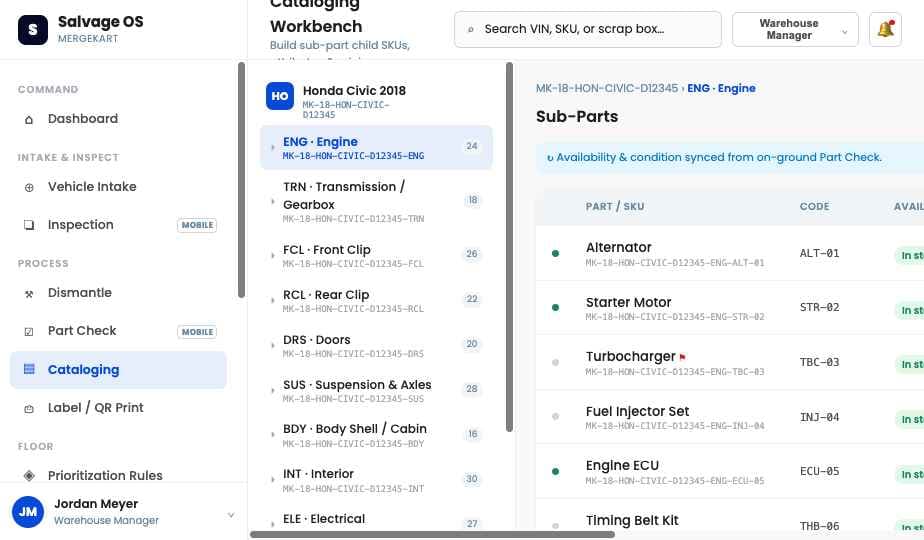
One VIN, eleven assemblies, 24 sub-parts under the engine alone — all SKU’d automatically.
11
assembly SKUs from one VIN
auto-generated with QR labels
2 min
to locate a stored part
down from ~20 minutes
62%
recovery per vehicle
parts + scrap vs acquisition
“Every part now points back at its VIN without anyone writing anything down. That is the whole difference.”

“100% of parts traceable to their donor vehicle”
Works better with
Salvage OS runs the yard; the horizontals sell what comes out of it.
OmniList
Lists parts on eBay Motors and beyond
OpsPilot
Guided pick from the stored location
PixelMagic
Cleans part photos taken on the floor
Vertical · from ₹4,800/mo
See full pricing →Questions sellers actually ask.
The salvage lifecycle end to end: vehicle intake, dismantle workflow, cataloguing, put-away and listing the recovered parts.
QR-based tracking keeps a part attached to its donor vehicle from dismantle through to the shelf it sits on and the order it ships against.
Listing is a step in the cataloguing workflow rather than a separate job, using the same catalogue the rest of the platform uses.
It covers intake through sale for salvage specifically. Whether it replaces your current system depends on what else that system does — worth walking through in a demo.
Walk us through one vehicle.
Bring a VIN and an acquisition cost. We will show the intake, the assemblies and the recovery maths.
No card for the first 14 days · your catalogue, not a sandbox